This poem comes from the Silva distichorum moralium by François Oudin (1719).
Promissor Futilis
Futilis est, qui multa solet promittere; magnus
Denique promissor dat, nisi verba, nihil.
The vocabulary is keyed to the DCC Latin Vocabulary list. There are two words in this poem that are not on the DCC list:
fūtilis, -e (fūtilis): worthless, vain
prōmissor (prōmissōris, m.): promiser, guarantor
dēnique: finally
dō dare dedī datum: give
māgnus -a -um great
multus -a -um: much, many; multō, by far
nihil, nīl: nothing; not at all
nisi/nī: if not, unless
prōmittō -mittere -mīsī -missum: send forth, offer
qui quae quod: who, which, what / quis quid: who? what? which?
soleō -ēre -uī -itum: be accustomed
sum, esse, fuī: be, exist
verbum -ī n.: word
Thursday, June 30, 2011
Wednesday, June 29, 2011
Mores Alieni
This poem comes from the Silva distichorum moralium by François Oudin (1719).
Mores Alieni
Rectius ut vivas, alienos consule mores:
Exprime quae laudas; quae secus, illa fuge.
The vocabulary is keyed to the DCC Latin Vocabulary list. There are two words in this poem that are not on the DCC list:
exprimō, exprimere: express, copy
secus: otherwise, differently
aliēnus -a -um: foreign, strange
cōnsulō -sulere -suluī -sultum: consult, plan
fugiō fugere fūgī fugitum: flee, escape
ille illa illud: that
laudō -āre: praise
mōs mōris m.: custom, habit; (pl.) character
qui quae quod: who, which, what / quis quid: who? what? which?
rectus -a -um: straight, direct
ut, uti: as (+ indic.); so that, with the result that (+ subj.)
vīvō vīvere vīxī victum: live
Mores Alieni
Rectius ut vivas, alienos consule mores:
Exprime quae laudas; quae secus, illa fuge.
The vocabulary is keyed to the DCC Latin Vocabulary list. There are two words in this poem that are not on the DCC list:
exprimō, exprimere: express, copy
secus: otherwise, differently
aliēnus -a -um: foreign, strange
cōnsulō -sulere -suluī -sultum: consult, plan
fugiō fugere fūgī fugitum: flee, escape
ille illa illud: that
laudō -āre: praise
mōs mōris m.: custom, habit; (pl.) character
qui quae quod: who, which, what / quis quid: who? what? which?
rectus -a -um: straight, direct
ut, uti: as (+ indic.); so that, with the result that (+ subj.)
vīvō vīvere vīxī victum: live
Labels:
DCC2,
Illustrated,
Oudin
Tuesday, June 28, 2011
Meditata Loquare
This poem comes from the Silva distichorum moralium by François Oudin (1719).
Meditata Loquare
Pauca diuque, puer, meditata loquare; loquenti
Quod semel exciderit, non revocare licet.
The vocabulary is keyed to the DCC Latin Vocabulary list. There are two words in this poem that are not on the DCC list:
excidō, excidere, excidī: fall out, escape
meditātus, -a, -um: considered, pondered
diū: for a long time
licet licuit licitum est: it is permitted (+ dat. of person + infin.); conj. licet: even though
loquor loquī locūtus sum: speak, talk
nōn: not
paucī -ae -a: few
puer puerī m.: boy; slave
que (enclitic) - and
qui quae quod: who, which, what / quis quid: who? what? which?
revocō -āre: call back, recall
semel: once

Meditata Loquare
Pauca diuque, puer, meditata loquare; loquenti
Quod semel exciderit, non revocare licet.
The vocabulary is keyed to the DCC Latin Vocabulary list. There are two words in this poem that are not on the DCC list:
excidō, excidere, excidī: fall out, escape
meditātus, -a, -um: considered, pondered
diū: for a long time
licet licuit licitum est: it is permitted (+ dat. of person + infin.); conj. licet: even though
loquor loquī locūtus sum: speak, talk
nōn: not
paucī -ae -a: few
puer puerī m.: boy; slave
que (enclitic) - and
qui quae quod: who, which, what / quis quid: who? what? which?
revocō -āre: call back, recall
semel: once

Labels:
DCC2,
Illustrated,
Oudin
Monday, June 27, 2011
Qui Tacere Scit
This poem comes from the Silva distichorum moralium by François Oudin (1719).
Qui Tacere Scit
Multa loqui scite est equidem laus magna, sed illa
Maiorem, qui scit multa tacere, refert.
The vocabulary is keyed to the DCC Latin Vocabulary list. There are two words in this poem that are not on the DCC list:
equidem: indeed, certainly
scītē: expertly, knowledgeably
ille illa illud: that
laus laudis f.: praise, glory
loquor loquī locūtus sum: speak, talk
māgnus -a -um great
māior -ius: greater, older; maiōres -um: ancestors
multus -a -um: much, many; multō, by far
qui quae quod: who, which, what / quis quid: who? what? which?
referō -ferre -tulī -lātum: bring back; report
sciō -īre -īvī/-iī -ītum: know
sed: but
sum, esse, fuī: be, exist
taceō -ēre -uī -itum: be silent; tacitus -a -um, silent
Qui Tacere Scit
Multa loqui scite est equidem laus magna, sed illa
Maiorem, qui scit multa tacere, refert.
The vocabulary is keyed to the DCC Latin Vocabulary list. There are two words in this poem that are not on the DCC list:
equidem: indeed, certainly
scītē: expertly, knowledgeably
ille illa illud: that
laus laudis f.: praise, glory
loquor loquī locūtus sum: speak, talk
māgnus -a -um great
māior -ius: greater, older; maiōres -um: ancestors
multus -a -um: much, many; multō, by far
qui quae quod: who, which, what / quis quid: who? what? which?
referō -ferre -tulī -lātum: bring back; report
sciō -īre -īvī/-iī -ītum: know
sed: but
sum, esse, fuī: be, exist
taceō -ēre -uī -itum: be silent; tacitus -a -um, silent
Labels:
DCC2,
Illustrated,
Oudin
Sunday, June 26, 2011
Qui Secum Vivere Potest
This poem comes from the Silva distichorum moralium by François Oudin (1719).
Qui Secum Vivere Potest
Saepe hominum coetus fugiat, qui taedia non vult
Longa pati, secum vivere quique potest.
The vocabulary is keyed to the DCC Latin Vocabulary list. There are two words in this poem that are not on the DCC list:
coetus (coetūs, m.): gathering, crowd, society
taedium (taediī, n.): weariness, tedium
cum: with (prep. + abl.); when, since, although (conjunction + subj.)
fugiō fugere fūgī fugitum: flee, escape
homo hominis m.: human being
longus -a -um: long, far; longē: far, far off
nōn: not
patior patī passus sum: permit, endure
possum posse potuī: be able
que (enclitic) - and
qui quae quod: who, which, what / quis quid: who? what? which?
saepe: often
sui, sibi, sē: him- her- itself
vīvō vīvere vīxī victum: live
volō velle voluī: wish, be willing
Qui Secum Vivere Potest
Saepe hominum coetus fugiat, qui taedia non vult
Longa pati, secum vivere quique potest.
The vocabulary is keyed to the DCC Latin Vocabulary list. There are two words in this poem that are not on the DCC list:
coetus (coetūs, m.): gathering, crowd, society
taedium (taediī, n.): weariness, tedium
cum: with (prep. + abl.); when, since, although (conjunction + subj.)
fugiō fugere fūgī fugitum: flee, escape
homo hominis m.: human being
longus -a -um: long, far; longē: far, far off
nōn: not
patior patī passus sum: permit, endure
possum posse potuī: be able
que (enclitic) - and
qui quae quod: who, which, what / quis quid: who? what? which?
saepe: often
sui, sibi, sē: him- her- itself
vīvō vīvere vīxī victum: live
volō velle voluī: wish, be willing
Labels:
DCC2,
Illustrated,
Oudin
Saturday, June 25, 2011
E Libris Opes
This poem comes from the Silva distichorum moralium by François Oudin (1719).
E Libris Opes
Quid tibi de lusu superest, cum luseris? At quas
Legeris e libris, mens tibi servat opes.
The vocabulary is keyed to the DCC Latin Vocabulary list. There are two words in this poem that are not on the DCC list:
lūdo, lūdere: play, mock, ridicule
lūsus (lūsūs, m.): play, game, amusement
at: but, but yet
cum: with (prep. + abl.); when, since, although (conjunction + subj.)
dē: down from, about, concerning (+ abl.)
ex ē: out of, from (+ abl.)
legō legere lēgī lēctum: gather, choose, read
liber librī m.: book
mēns mentis f.: mind
ops opis f.: assistance, resources
qui quae quod: who, which, what / quis quid: who? what? which?
servō -āre: save, watch over
supersum -esse -fuī: be above; remain, survive
tū tuī tibi tē: you (sing.)
E Libris Opes
Quid tibi de lusu superest, cum luseris? At quas
Legeris e libris, mens tibi servat opes.
The vocabulary is keyed to the DCC Latin Vocabulary list. There are two words in this poem that are not on the DCC list:
lūdo, lūdere: play, mock, ridicule
lūsus (lūsūs, m.): play, game, amusement
at: but, but yet
cum: with (prep. + abl.); when, since, although (conjunction + subj.)
dē: down from, about, concerning (+ abl.)
ex ē: out of, from (+ abl.)
legō legere lēgī lēctum: gather, choose, read
liber librī m.: book
mēns mentis f.: mind
ops opis f.: assistance, resources
qui quae quod: who, which, what / quis quid: who? what? which?
servō -āre: save, watch over
supersum -esse -fuī: be above; remain, survive
tū tuī tibi tē: you (sing.)
Labels:
DCC2,
Illustrated,
Oudin
Friday, June 24, 2011
Libros Gesta
This poem comes from the Silva distichorum moralium by François Oudin (1719).
Libros Gesta
Arma palam gestat sua miles amatque videri;
At tua quos gestas sunt, puer, arma libri.
The vocabulary is keyed to the DCC Latin Vocabulary list. There are two words in this poem that are not on the DCC list:
gestō, gestāre: carry, bear, wear
palam: openly, plainly
amō -āre: to love; amans -ntis m./f.: lover
arma -ōrum n. pl.: arms
at: but, but yet
liber librī m.: book
mīles -itis m.: soldier
puer puerī m.: boy; slave
que (enclitic) - and
qui quae quod: who, which, what / quis quid: who? what? which?
sum, esse, fuī: be, exist
suus -a -um: his own, her own, its own
tuus -a -um: your
videō vidēre vīdī vīsum: see
Libros Gesta
Arma palam gestat sua miles amatque videri;
At tua quos gestas sunt, puer, arma libri.
The vocabulary is keyed to the DCC Latin Vocabulary list. There are two words in this poem that are not on the DCC list:
gestō, gestāre: carry, bear, wear
palam: openly, plainly
amō -āre: to love; amans -ntis m./f.: lover
arma -ōrum n. pl.: arms
at: but, but yet
liber librī m.: book
mīles -itis m.: soldier
puer puerī m.: boy; slave
que (enclitic) - and
qui quae quod: who, which, what / quis quid: who? what? which?
sum, esse, fuī: be, exist
suus -a -um: his own, her own, its own
tuus -a -um: your
videō vidēre vīdī vīsum: see
Labels:
DCC2,
Illustrated,
Oudin
Thursday, June 23, 2011
Rerum plus mundus...
Rerum plus mundus microcosmo continet in se.
Errorum cosmo plus microcosmus habet.
Source: Owen 12.29. De homine et mundo
Meter: elegiac
res - thing
plus - more
mundus - world
microcosmus - miniature world, man
contineo - contain, hold
in - in
se - himself, herself, itself (reflexive)
error - error, mistake
cosmus - world
habeo - have
Errorum cosmo plus microcosmus habet.
Source: Owen 12.29. De homine et mundo
Meter: elegiac
res - thing
plus - more
mundus - world
microcosmus - miniature world, man
contineo - contain, hold
in - in
se - himself, herself, itself (reflexive)
error - error, mistake
cosmus - world
habeo - have
Errorum cosmo plus microcosmus habet.
Wednesday, June 22, 2011
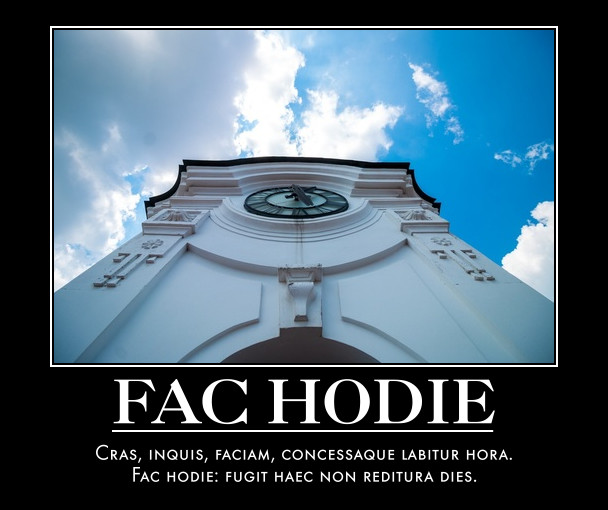
Fac Hodie
Here is a distich by Michele Verinus:
Fac Hodie
Cras, inquis, faciam, concessaque labitur hora;
Fac hodie: fugit haec non reditura dies.
The vocabulary is keyed to the DCC Latin Vocabulary list. There are two words in this poem that are not on the DCC list:
I'll do it, you say, tomorrow, and the allowed time slips by. Do it today: this day is escaping, not to return.
crās: tomorrow
lābor, lābī: slip, glide, fall
concēdō -cēdere -cessī -cessum: yield, withdraw
contrā: against, opposite (adv. and prep. +acc.)
diēs diēī m./f.: day
faciō facere fēcī factum: do, make
fugiō fugere fūgī fugitum: flee, escape
hic haec hoc: this; hōc: on this account
hodiē: today
hōra -ae f.: hour
inquam: say (used with direct speech)
nōn: not
que (enclitic) - and
redeō -īre -iī -itum: go back, return
Tuesday, June 21, 2011
Ortu nobilior...
Ortu nobilior quam vir suus Eva, quod illa
Nata viro, terrae filius ille fuit.
Source: Owen 12.22. Utrum vir an mulier generosior
Meter: elegiac
ortus - origin, beginning, birth
nobilis - noble
quam - than
vir - man, husband,
suus - his, her, its (reflexive)
Eva - Eve
quod - because
illa - she, that one
natus - born
terra - land, earth
filius - son
ille - he, that one
Nata viro, terrae filius ille fuit.
Source: Owen 12.22. Utrum vir an mulier generosior
Meter: elegiac
ortus - origin, beginning, birth
nobilis - noble
quam - than
vir - man, husband,
suus - his, her, its (reflexive)
Eva - Eve
quod - because
illa - she, that one
natus - born
terra - land, earth
filius - son
ille - he, that one
Monday, June 20, 2011
Dies Ultima
Here is a distich by Michele Verinus:
Dies Ultima
Tolle moras: volucres menses labuntur et anni;
Ultima sit nescis quando futura dies.
The vocabulary is keyed to the DCC Latin Vocabulary list. There are two words in this poem that are not on the DCC list:
Don't delay (tolle moras): the swift months (volucres menses) and years (et anni) are slipping away (labuntur); you do not know when (nescis quando) your last day (ultima dies) will be (futura sit).
lābor, lābī: slip, glide, fall
mensis (mensis, m.): month
annus -ī m.: year
contrā: against, opposite (adv. and prep. +acc.)
diēs diēī m./f.: day
et: and
mora -ae f.: delay, hindrance
nesciō -scīre: not know, be ignorant
quandō: when?; since; si quando: if ever
sum, esse, fuī: be, exist
tollō tollere sustulī sublātum: raise up, destroy
ūltimus -a -um: farthest, final, last, ultimate
volucer -cris -cre: flying; volucris -is m./f.: bird
Sunday, June 19, 2011
Quaerit avarus opes...
Quaerit avarus opes, Linus ambitiosus honores.
Nanus avaritia est, ambitione gigas.
Source: Owen 12.21. In Linum
Meter: elegiac
quaero - seek, search for
avarus - greedy, selfish
ops - power, might / opes - resources, wealth
ambitiosus - ambitious
honor - public office, regard
nanus - dwarf
avaritia - greediness, selfishness
sum - be, exist,
ambitio - ambition
gigas - giant
Nanus avaritia est, ambitione gigas.
Source: Owen 12.21. In Linum
Meter: elegiac
quaero - seek, search for
avarus - greedy, selfish
ops - power, might / opes - resources, wealth
ambitiosus - ambitious
honor - public office, regard
nanus - dwarf
avaritia - greediness, selfishness
sum - be, exist,
ambitio - ambition
gigas - giant
Saturday, June 18, 2011
Amici Paucissimi
Here is a distich by Michele Verinus:
Amici Paucissimi
Millibus ex multis unus vix fidus amicus;
Hic albo corvo rarior esse solet.
The vocabulary is keyed to the DCC Latin Vocabulary list. There are two words in this poem that are not on the DCC list:
corvus (corvi, m.): crow, raven
fīdus, -a, -um: faithful, loyal
albus -a -um: white
amīcus -a -um: friendly; (as subst.) friend
ex ē: out of, from (+ abl.)
hic haec hoc: this; hōc: on this account
mille (pl.) milia: thousand
multus -a -um: much, many; multō, by far
paucī -ae -a: few
rarus -a -um: wide apart, loose, thin; rare, seldom
soleō -ēre -uī -itum: be accustomed
sum, esse, fuī: be, exist
ūnus -a -um: one
vix: scarcely
Amici Paucissimi
Millibus ex multis unus vix fidus amicus;
Hic albo corvo rarior esse solet.
The vocabulary is keyed to the DCC Latin Vocabulary list. There are two words in this poem that are not on the DCC list:
corvus (corvi, m.): crow, raven
fīdus, -a, -um: faithful, loyal
albus -a -um: white
amīcus -a -um: friendly; (as subst.) friend
ex ē: out of, from (+ abl.)
hic haec hoc: this; hōc: on this account
mille (pl.) milia: thousand
multus -a -um: much, many; multō, by far
paucī -ae -a: few
rarus -a -um: wide apart, loose, thin; rare, seldom
soleō -ēre -uī -itum: be accustomed
sum, esse, fuī: be, exist
ūnus -a -um: one
vix: scarcely
Labels:
DCC2,
Illustrated,
Verinus
Friday, June 17, 2011
Caeca dea est...
Caeca dea est rerum rectrix, Fortuna vocatur.
Non minus at caeci, quos dea caeca regit.
Source: Owen 12.20. Vitam regit Fortuna non Sapientia
Meter: elegiac
caecus - blind
dea - goddess
sum - be, exist
res - thing, matter, business
rectrix - director (fem.)
Fortuna - Fortune, Lady Luck
voco - call
non - not, no
minus - less
at - but, whereas, on the contrary
qui - who, which, that
rego - direct, guide, command
Non minus at caeci, quos dea caeca regit.
Source: Owen 12.20. Vitam regit Fortuna non Sapientia
Meter: elegiac
caecus - blind
dea - goddess
sum - be, exist
res - thing, matter, business
rectrix - director (fem.)
Fortuna - Fortune, Lady Luck
voco - call
non - not, no
minus - less
at - but, whereas, on the contrary
qui - who, which, that
rego - direct, guide, command
Thursday, June 16, 2011
Liberalis
Here is a distich by Michele Verinus:
Liberalis
Quas inopi et dulci laetus donabis amico,
Temporibus nullis eripientur opes.
The vocabulary is keyed to the DCC Latin Vocabulary list. There are two words in this poem that are not on the DCC list:
inops (inopis): needy, lacking, destitute
līberālis, -e (līberālis): honorable, generous
amīcus -a -um: friendly; (as subst.) friend
dōnō -āre: present with a gift (+ acc. of person and abl. of thing)
dulcis -e: sweet
ēripiō -ripere -ripuī -reptum: snatch away, rescue, save
et: and
laetus -a -um: glad, joyful
nūllus -a -um: not any, no one
ops opis f.: assistance, resources
qui quae quod: who, which, what / quis quid: who? what? which?
tempus -oris n.: time
Liberalis
Quas inopi et dulci laetus donabis amico,
Temporibus nullis eripientur opes.
The vocabulary is keyed to the DCC Latin Vocabulary list. There are two words in this poem that are not on the DCC list:
inops (inopis): needy, lacking, destitute
līberālis, -e (līberālis): honorable, generous
amīcus -a -um: friendly; (as subst.) friend
dōnō -āre: present with a gift (+ acc. of person and abl. of thing)
dulcis -e: sweet
ēripiō -ripere -ripuī -reptum: snatch away, rescue, save
et: and
laetus -a -um: glad, joyful
nūllus -a -um: not any, no one
ops opis f.: assistance, resources
qui quae quod: who, which, what / quis quid: who? what? which?
tempus -oris n.: time
Labels:
DCC2,
Illustrated,
Verinus
Wednesday, June 15, 2011
Ioannes quondam caruit...
Ioannes quondam caruit sermone Latino,
Vestitu, victu, nunc et honore caret.
Source: Owen 12.51. Sir John Lack-Latin
Meter: elegiac
Ioannes - John
quondam - once, at one time, formerly
careo - lack
sermo - speech, language
Latinus - Latin
vestitus - clothing
victus - food
nunc - now
et - and, also
honor - esteem, dignity, public regard
Vestitu, victu, nunc et honore caret.
Source: Owen 12.51. Sir John Lack-Latin
Meter: elegiac
Ioannes - John
quondam - once, at one time, formerly
careo - lack
sermo - speech, language
Latinus - Latin
vestitus - clothing
victus - food
nunc - now
et - and, also
honor - esteem, dignity, public regard
Tuesday, June 14, 2011
Tu duc Stultitiam...
Tu duc Stultitiam, mihi sit Sapientia coniunx.
Tu regito uxorem, me mea nupta regat.
Source: Owen 12.18. AD M. L.
Meter: elegiac
tu - you
duco - lead, marry
stultitia - foolishness
ego - I
sum - be, exist
sapientia - wisdom
coniunx - spouse
rego - rule, direct, command
uxor - wife
meus - my, mind
nupta - bride
Tu regito uxorem, me mea nupta regat.
Source: Owen 12.18. AD M. L.
Meter: elegiac
tu - you
duco - lead, marry
stultitia - foolishness
ego - I
sum - be, exist
sapientia - wisdom
coniunx - spouse
rego - rule, direct, command
uxor - wife
meus - my, mind
nupta - bride
Monday, June 13, 2011
Verba homines facimus...
Verba homines facimus, fecit Deus omnia verbo.
Ipse Deus verbum est, nos quoque verba sumus.
Source: Owen 12.49. In Principio Erat Verbum
verbum - word
homo - person, man
facio - make, do, create
Deus - god
omnis - all, every
ipse - (emphatic pronoun)
sum - be, exist
nos - we
quoque - also
Ipse Deus verbum est, nos quoque verba sumus.
Source: Owen 12.49. In Principio Erat Verbum
verbum - word
homo - person, man
facio - make, do, create
Deus - god
omnis - all, every
ipse - (emphatic pronoun)
sum - be, exist
nos - we
quoque - also
Sunday, June 12, 2011
Socius Mensae
Here is a distich by Michele Verinus:
Socius Mensae
Qui socius mensae est, verum ne reris amicum:
Tolle epulas; nosces quam tibi fidus erat.
The vocabulary is keyed to the DCC Latin Vocabulary list. There are two words in this poem that are not on the DCC list:
epulae (epularum, f. pl.): banquet, dinner, feast
fīdus, -a, -um: faithful, loyal
amīcus -a -um: friendly; (as subst.) friend
mēnsa -ae f.: table
nē: lest, that not
nōscō nōscere nōvī nōtum: learn, know
quam: how?; (after comparative) than
qui quae quod: who, which, what / quis quid: who? what? which?
reor rērī rātus sum: think, imagine, suppose, deem
socius -a -um: friendly, allied; socius -i m.: partner, comrade
sum, esse, fuī: be, exist
tollō tollere sustulī sublātum: raise up, destroy
tū tuī tibi tē: you (sing.)
vērus -a -um: true; vērē, truly
Socius Mensae
Qui socius mensae est, verum ne reris amicum:
Tolle epulas; nosces quam tibi fidus erat.
The vocabulary is keyed to the DCC Latin Vocabulary list. There are two words in this poem that are not on the DCC list:
epulae (epularum, f. pl.): banquet, dinner, feast
fīdus, -a, -um: faithful, loyal
amīcus -a -um: friendly; (as subst.) friend
mēnsa -ae f.: table
nē: lest, that not
nōscō nōscere nōvī nōtum: learn, know
quam: how?; (after comparative) than
qui quae quod: who, which, what / quis quid: who? what? which?
reor rērī rātus sum: think, imagine, suppose, deem
socius -a -um: friendly, allied; socius -i m.: partner, comrade
sum, esse, fuī: be, exist
tollō tollere sustulī sublātum: raise up, destroy
tū tuī tibi tē: you (sing.)
vērus -a -um: true; vērē, truly
Labels:
DCC2,
Illustrated,
Verinus
Saturday, June 11, 2011
Virtus Reddit Immortales
Here is a distich by Michele Verinus:
Virtus Reddit Immortales
Omnia cum pereant, virtus est sola perennis;
Haec immortales reddere sola potest.
The vocabulary is keyed to the DCC Latin Vocabulary list. There are two words in this poem that are not on the DCC list:
immortālis, -e (immortalis): immortal, endless, eternal
perennis, -e (perennis): lasting through the years
cum: with (prep. + abl.); when, since, although (conjunction + subj.)
hic haec hoc: this; hōc: on this account
omnis -e: all, every, as a whole
pereō -īre -iī -itum: perish, be lost
possum posse potuī: be able
reddō -dere -didī -ditum: return, give back
sōlus -a -um: only, alone; sōlum (adv.), only, merely
sum, esse, fuī: be, exist
virtūs -ūtis f.: valor, manliness, virtue
Virtus Reddit Immortales
Omnia cum pereant, virtus est sola perennis;
Haec immortales reddere sola potest.
The vocabulary is keyed to the DCC Latin Vocabulary list. There are two words in this poem that are not on the DCC list:
immortālis, -e (immortalis): immortal, endless, eternal
perennis, -e (perennis): lasting through the years
cum: with (prep. + abl.); when, since, although (conjunction + subj.)
hic haec hoc: this; hōc: on this account
omnis -e: all, every, as a whole
pereō -īre -iī -itum: perish, be lost
possum posse potuī: be able
reddō -dere -didī -ditum: return, give back
sōlus -a -um: only, alone; sōlum (adv.), only, merely
sum, esse, fuī: be, exist
virtūs -ūtis f.: valor, manliness, virtue
Labels:
DCC2,
Illustrated,
Verinus
Friday, June 10, 2011
Conscientia Bona
Here is a distich by Michele Verinus:
Conscientia Bona
Qui recte vivit, contemnit iussa superbi;
Conscia mens recti nil timuisse potest.
The vocabulary is keyed to the DCC Latin Vocabulary list. There are two words in this poem that are not on the DCC list:
conscientia (conscientiae, f.): conscience, sense of guilt
conscius, -a, -um: knowing, conscious, guilty
bonus -a -um: good
contemnō -temnere -tempsī -temptum: despise, scorn, disdain
iubeō iubēre iūssī iūssum: bid, order
mēns mentis f.: mind
nihil, nīl: nothing; not at all
possum posse potuī: be able
qui quae quod: who, which, what / quis quid: who? what? which?
rectus -a -um: straight, direct
superbus -a -um: overbearing, proud, haughty
timeō -ēre -uī: to fear, to dread
vīvō vīvere vīxī victum: live
Conscientia Bona
Qui recte vivit, contemnit iussa superbi;
Conscia mens recti nil timuisse potest.
The vocabulary is keyed to the DCC Latin Vocabulary list. There are two words in this poem that are not on the DCC list:
conscientia (conscientiae, f.): conscience, sense of guilt
conscius, -a, -um: knowing, conscious, guilty
bonus -a -um: good
contemnō -temnere -tempsī -temptum: despise, scorn, disdain
iubeō iubēre iūssī iūssum: bid, order
mēns mentis f.: mind
nihil, nīl: nothing; not at all
possum posse potuī: be able
qui quae quod: who, which, what / quis quid: who? what? which?
rectus -a -um: straight, direct
superbus -a -um: overbearing, proud, haughty
timeō -ēre -uī: to fear, to dread
vīvō vīvere vīxī victum: live
Labels:
DCC2,
Illustrated,
Verinus
Thursday, June 9, 2011
Consilium Vertere
Here is a distich by Michele Verinus:
Consilium Vertere
Errare est hominis, sed non persistere; saepe
Optimus est portus vertere consilium.
The vocabulary is keyed to the DCC Latin Vocabulary list. There are two words in this poem that are not on the DCC list:
persistō, persistere: continue steadfastly, persist
portus (portūs, m.): harbor, haven, port
cōnsilium -ī n.: plan; council, group of advisors
errō -āre: go astray, wander
homo hominis m.: human being
nōn: not
optimus -a -um: best, excellent; adv. optimē
saepe: often
sed: but
sum, esse, fuī: be, exist
vertō vertere vertī versum: turn
Consilium Vertere
Errare est hominis, sed non persistere; saepe
Optimus est portus vertere consilium.
The vocabulary is keyed to the DCC Latin Vocabulary list. There are two words in this poem that are not on the DCC list:
persistō, persistere: continue steadfastly, persist
portus (portūs, m.): harbor, haven, port
cōnsilium -ī n.: plan; council, group of advisors
errō -āre: go astray, wander
homo hominis m.: human being
nōn: not
optimus -a -um: best, excellent; adv. optimē
saepe: often
sed: but
sum, esse, fuī: be, exist
vertō vertere vertī versum: turn
Labels:
DCC2,
Illustrated,
Verinus
Tuesday, June 7, 2011
Credere Se Alienis
Here is a distich by Michele Verinus:
Credere Se Alienis
Non est tuta salus alienis credita telis;
Venales mutat quaelibet aura manus.
The vocabulary is keyed to the DCC Latin Vocabulary list. There are two words in this poem that are not on the DCC list:
quīlibet, quaelibet, quodlibet: whoever, anybody
vēnālis, -e (vēnālis): for sale, for hire
aliēnus -a -um: foreign, strange
aura -ae f.: breeze
crēdō crēdere crēdidī crēditum: believe
manus -ūs m.: hand; band of men
mūtō -āre: change
nōn: not
salūs -ūtis f.: health, safety
sui, sibi, sē: him- her- itself
sum, esse, fuī: be, exist
tēlum -ī n.: missile, weapon, spear
tutus -a -um: safe, protected
Credere Se Alienis
Non est tuta salus alienis credita telis;
Venales mutat quaelibet aura manus.
The vocabulary is keyed to the DCC Latin Vocabulary list. There are two words in this poem that are not on the DCC list:
quīlibet, quaelibet, quodlibet: whoever, anybody
vēnālis, -e (vēnālis): for sale, for hire
aliēnus -a -um: foreign, strange
aura -ae f.: breeze
crēdō crēdere crēdidī crēditum: believe
manus -ūs m.: hand; band of men
mūtō -āre: change
nōn: not
salūs -ūtis f.: health, safety
sui, sibi, sē: him- her- itself
sum, esse, fuī: be, exist
tēlum -ī n.: missile, weapon, spear
tutus -a -um: safe, protected
Labels:
DCC2,
Illustrated,
Verinus
Sunday, June 5, 2011
In Tribulatione Virtus
Here is a distich by Michele Verinus:
In Tribulatione Virtus
Quod fornax auro, facit hoc tribulatio iustis;
Rebus in adversis certa probanda fides.
The vocabulary is keyed to the DCC Latin Vocabulary list. There are two words in this poem that are not on the DCC list:
fornax (fornācis, f.): furnace, oven
trībulātio (trībulātiōnis, f.): distress, trouble
adversus -a -um: facing, opposed; unfavorable; adversus (-um): (adv. and prep.) facing, opposite, against, opposed (to)
aurum -ī n.: gold
certus -a -um: sure, fixed; certē, certainly, surely
faciō facere fēcī factum: do, make
fidēs -eī f.: trust, faith
hic haec hoc: this; hōc: on this account
in: in, on (+ abl.); into, onto (+ acc)
iūstus -a -um: right, just, fair
probō -āre: approve, prove; convince one (dat.) of a thing (acc.)
qui quae quod: who, which, what / quis quid: who? what? which?
rēs reī f.: thing (rēs pūblica, commonwealth; rēs familiāris, family property, estate; rēs mīlitāris, art of war; rēs novae, revolution)
virtūs -ūtis f.: valor, manliness, virtue
In Tribulatione Virtus
Quod fornax auro, facit hoc tribulatio iustis;
Rebus in adversis certa probanda fides.
The vocabulary is keyed to the DCC Latin Vocabulary list. There are two words in this poem that are not on the DCC list:
fornax (fornācis, f.): furnace, oven
trībulātio (trībulātiōnis, f.): distress, trouble
adversus -a -um: facing, opposed; unfavorable; adversus (-um): (adv. and prep.) facing, opposite, against, opposed (to)
aurum -ī n.: gold
certus -a -um: sure, fixed; certē, certainly, surely
faciō facere fēcī factum: do, make
fidēs -eī f.: trust, faith
hic haec hoc: this; hōc: on this account
in: in, on (+ abl.); into, onto (+ acc)
iūstus -a -um: right, just, fair
probō -āre: approve, prove; convince one (dat.) of a thing (acc.)
qui quae quod: who, which, what / quis quid: who? what? which?
rēs reī f.: thing (rēs pūblica, commonwealth; rēs familiāris, family property, estate; rēs mīlitāris, art of war; rēs novae, revolution)
virtūs -ūtis f.: valor, manliness, virtue
Labels:
DCC2,
Illustrated,
Verinus
Friday, June 3, 2011
De Caritate
Here is a distich by Michele Verinus:
De Caritate
Est caritas perfectus amor perfectaque virtus,
Qua sine perfectum nil reperire potes.
The vocabulary is keyed to the DCC Latin Vocabulary list. There are two words in this poem that are not on the DCC list:
cāritas (cāritātis, f.): love, charity
perfectus, -a, -um: accomplished, finished
amor -ōris m.: love
nihil, nīl: nothing; not at all
possum posse potuī: be able
que (enclitic) - and
qui quae quod: who, which, what / quis quid: who? what? which?
reperiō -perīre -perī -pertum: find, find out
sine: without (+ abl.)
sum, esse, fuī: be, exist
virtūs -ūtis f.: valor, manliness, virtue
De Caritate
Est caritas perfectus amor perfectaque virtus,
Qua sine perfectum nil reperire potes.
The vocabulary is keyed to the DCC Latin Vocabulary list. There are two words in this poem that are not on the DCC list:
cāritas (cāritātis, f.): love, charity
perfectus, -a, -um: accomplished, finished
amor -ōris m.: love
nihil, nīl: nothing; not at all
possum posse potuī: be able
que (enclitic) - and
qui quae quod: who, which, what / quis quid: who? what? which?
reperiō -perīre -perī -pertum: find, find out
sine: without (+ abl.)
sum, esse, fuī: be, exist
virtūs -ūtis f.: valor, manliness, virtue
Labels:
DCC2,
Illustrated,
Verinus
Thursday, June 2, 2011
Nemo Dat Gratis
Here is a distich by Michele Verinus:
Nemo Dat Gratis
Munera qui mittit, sperat maiora remitti;
Nemo suas vellet perdere gratis opes.
The vocabulary is keyed to the DCC Latin Vocabulary list. There are two words in this poem that are not on the DCC list:
grātīs: without payment, freely
remitto, remittere: send back, return
dō dare dedī datum: give
māior -ius: greater, older; maiōres -um: ancestors
mittō mittere mīsī missum: send, let go
mūnus mūneris n.: gift, offering
nēmo: no one (gen. nullius, dat. nulli, abl. nullo or nulla > nullus -a -um)
ops opis f.: assistance, resources
perdō -dere -didī -ditum: destroy
qui quae quod: who, which, what / quis quid: who? what? which?
spērō -āre: to hope
suus -a -um: his own, her own, its own
volō velle voluī: wish, be willing
Nemo Dat Gratis
Munera qui mittit, sperat maiora remitti;
Nemo suas vellet perdere gratis opes.
The vocabulary is keyed to the DCC Latin Vocabulary list. There are two words in this poem that are not on the DCC list:
grātīs: without payment, freely
remitto, remittere: send back, return
dō dare dedī datum: give
māior -ius: greater, older; maiōres -um: ancestors
mittō mittere mīsī missum: send, let go
mūnus mūneris n.: gift, offering
nēmo: no one (gen. nullius, dat. nulli, abl. nullo or nulla > nullus -a -um)
ops opis f.: assistance, resources
perdō -dere -didī -ditum: destroy
qui quae quod: who, which, what / quis quid: who? what? which?
spērō -āre: to hope
suus -a -um: his own, her own, its own
volō velle voluī: wish, be willing
Labels:
DCC2,
Illustrated,
Verinus
Wednesday, June 1, 2011
Parce Laudato, Parcius Culpato
Here is a distich by Michele Verinus:
Parce Laudato, Parcius Culpato
Si quem laudaris, parce laudare memento:
Crimina culpato parcius ipsa tamen.
The vocabulary is keyed to the DCC Latin Vocabulary list. There are two words in this poem that are not on the DCC list:
culpō, culpāre: blame, find fault with
parcē: sparingly; parcius, comp. adv.
aliquis -quae -quod: some, any; si quis, si quid: anyone who, anything that
crīmen -inis n.: verdict, accusation
ipse ipsa ipsum: him- her- itself
laudō -āre: praise
meminī meminisse: remember, recollect
sī: if
tamen: nevertheless, still
Parce Laudato, Parcius Culpato
Si quem laudaris, parce laudare memento:
Crimina culpato parcius ipsa tamen.
The vocabulary is keyed to the DCC Latin Vocabulary list. There are two words in this poem that are not on the DCC list:
culpō, culpāre: blame, find fault with
parcē: sparingly; parcius, comp. adv.
aliquis -quae -quod: some, any; si quis, si quid: anyone who, anything that
crīmen -inis n.: verdict, accusation
ipse ipsa ipsum: him- her- itself
laudō -āre: praise
meminī meminisse: remember, recollect
sī: if
tamen: nevertheless, still
Labels:
DCC2,
Illustrated,
Verinus
Subscribe to:
Posts (Atom)